

WE PROTECT WHAT'S YOURS

We protect what matters most
Arca Ambiental operates based on principles that go beyond legal compliance. We protect the environment, ensure the safety of our clients’ projects, and promote the sustainability of their businesses, transforming environmental responsibility into value, continuity, and competitiveness.

Mission
Deliver technical, strategic, and innovative environmental solutions to our clients, ensuring compliance, sustainability, and balance between the environment, society, and economic activity.

Vision
Establish ourselves as a provider of integrated and innovative environmental solutions for our clients, promoting environmental protection and supporting the responsible development of society and enterprises.

Values
Environmental responsibility, Client care and commitment, Technical excellence, Ethics and transparency, Applied innovation, Commitment to sustainable results, and Professionalism.
Um Legado de Sucesso
Foram mais de doze anos de muito sucesso, sementes plantadas, frutos continuamente colhidos que resultam na satisfação dos nossos clientes.
12+
Anos de Sucesso
∞
Sementes Plantadas
100%
Frutos Colhidos
Our Solutions
We operate strategically across various environmental fronts, offering technical solutions that protect the environment and strengthen business continuity.

Frequently Asked Questions
Does every project or facility need an environmental permit to operate?
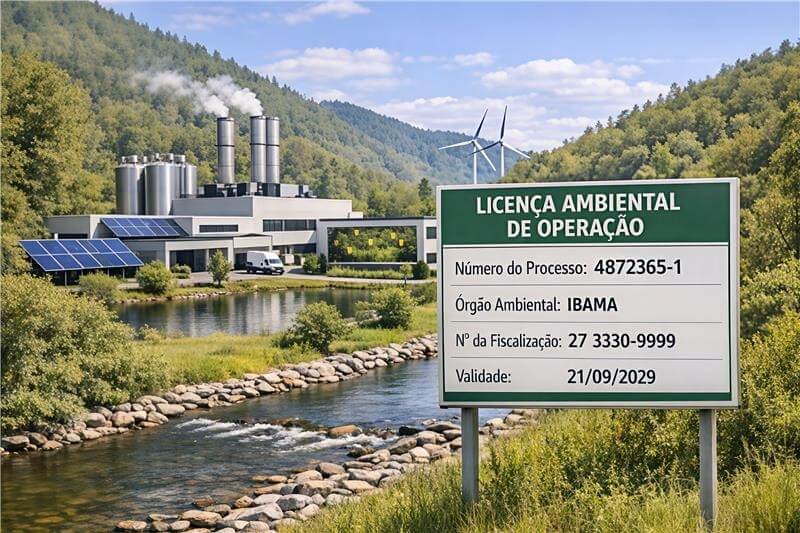
Not necessarily. The requirement for a permit depends on whether the activity/project uses environmental resources and/or is actually or potentially polluting, or may cause environmental degradation — as well as on the classification defined by the competent authority and applicable regulations.
CONAMA Resolution 237 defines “environmental permitting” and “environmental permit” precisely in these terms, as an administrative procedure/act carried out by the competent environmental authority.
In practice: even when an activity does not require a “classic” permit, there may still be specific authorizations, registrations, or controls depending on the case (for example, water resources, vegetation suppression, etc.).
Who determines which environmental studies (RCA, PCA, EIA/EIS, etc.) are required in the permitting process?
The competent environmental authority determines this, based on the project’s classification and applicable regulations.
CONAMA Resolution 237/1997 defines “environmental studies” as any study related to environmental aspects of the location/installation/operation/expansion of a project, citing examples such as reports and plans, and addresses the EIA/RIMA within the permitting context.
Once I obtain the environmental permit, do my obligations end — or are there ongoing requirements?
The permit does not “close” the process. By legal definition, an environmental permit establishes conditions, restrictions, and environmental control measures that the operator must comply with in order to locate, install, expand, and operate.
In other words, compliance with permit conditions and requirements is continuous throughout the permit’s validity.
In general, these obligations include monitoring, reporting, documentation, and control measures (depending on the case and on what the authority requires).
What can happen if I fail to comply with permit conditions or environmental standards?
Non-compliance may result in:
- Administrative sanctions (warnings, fines, embargo/suspension, etc.) under the environmental police power, according to Decree 6.514/2008.
- And in specific situations (such as operating without a permit), criminal liability, under Law 9.605/1998 (e.g., Article 60).
What are the consequences of operating with an expired permit? What should I do?
Operating without a valid permit (or in violation of regulations) may lead to administrative and criminal consequences.
- Criminal (environmental crime): Law 9.605/1998 defines as a crime the act of “operating” a potentially polluting establishment/activity without a permit or authorization from the competent authorities, or in violation of regulations.
- Administrative: Decree 6.514/2008 establishes environmental administrative infractions and sanctions, including fines, embargoes, and suspension of activities, among others.
Recommended technical practice: immediately file the renewal/regularization request, identify any pending conditions, and organize a compliance plan (the exact procedure depends on the authority).
When do I need a water-use permit (for abstraction/wells/discharge)?
Law 9.433/1997 (National Water Resources Policy) establishes management instruments, including the water-use permit and the classification of water bodies.
The specific requirements (thresholds, type of use, jurisdiction of the water body, etc.) depend on the managing authority and local regulations, but the federal basis for the instrument is in Law 9.433.
What is the legal difference between “discharging effluent into a water body” and “disposing effluent onto soil”?
CONAMA Resolution 430/2011 regulates discharges into water bodies and highlights an important point:
the disposal of effluents onto soil, even when treated, is not subject to the discharge parameters of Resolution 430, but it must not cause pollution or contamination of surface or groundwater.
This directly affects projects such as controlled infiltration, fertigation, and other forms of reuse/disposal, which may have specific regulations (such as CONAMA 503/2021 in certain sectors).
I want to reuse effluent for fertigation. What should I do?
Fertigation reuse has specific federal regulations in some cases.
CONAMA Resolution 503/2021 defines criteria and procedures for fertigation reuse of effluents from food, beverage, dairy, slaughterhouse, and rendering industries, including the definition of “stabilized effluent” and application conditions.
The same Resolution allows, in certain cases, the reuse of nonstabilized effluents, provided it is authorized by the competent environmental authority.
In technical practice (applied reference): monitoring reports often compare effluent/soil parameters with CONAMA 503 and effluent parameters also with CONAMA 430 (e.g., pH), reinforcing the need for soil monitoring and effluent quality control in fertigation contexts.
What are the business benefits of implementing an Environmental Management Program?
Beyond reducing the risk of fines and operational interruptions, the literature shows that structured environmental management can generate efficiency gains and economic performance improvements.
- The “environment vs. competitiveness” view can be overcome when standards and management drive innovation and resource productivity (less waste, more efficiency).
- Studies on certifications and systems (e.g., ISO 14001) show a positive association with economic/financial performance in meta-analyses.
In practice (typical benefits): better control of legal requirements/permit conditions, cost reduction through waste minimization, greater operational predictability, and improved risk governance. (These benefits vary by sector and system maturity.)
Does legislation require companies to provide environmental training/education for workers?
Yes. The National Environmental Education Policy (Law 9.795/1999) establishes that companies and institutions must promote programs aimed at training workers to improve and control the work environment and the environmental impacts of production processes.
This is directly connected to programs required in permitting (when conditions exist) and to good corporate environmental management practices.